
Backrooms, Euphoria
Weekly Roundup (05/25-06/01)

An astounding week for the box office, the unprecedented rise week-over-week of Obsession, continuing a historic word of mouth streak, crossing $100 million domestically on a $750,000 budget, beating out the second weekend of The Mandalorian and Grogu, with the backing of a multi-billion dollar studio, and the highest grossing opening weekend from one of the most beloved quasi-indie studios in A24. Not to mention that the directors atop the box office are both under 27 years old debuting original stories. It’s worth pausing for a second to appreciate how monumental this moment is; even if the studios learn the wrong lessons from this, it will undoubtedly change the landscape for moviemaking in the next decade; ride the wave.
Backrooms dir. Kane Parsons
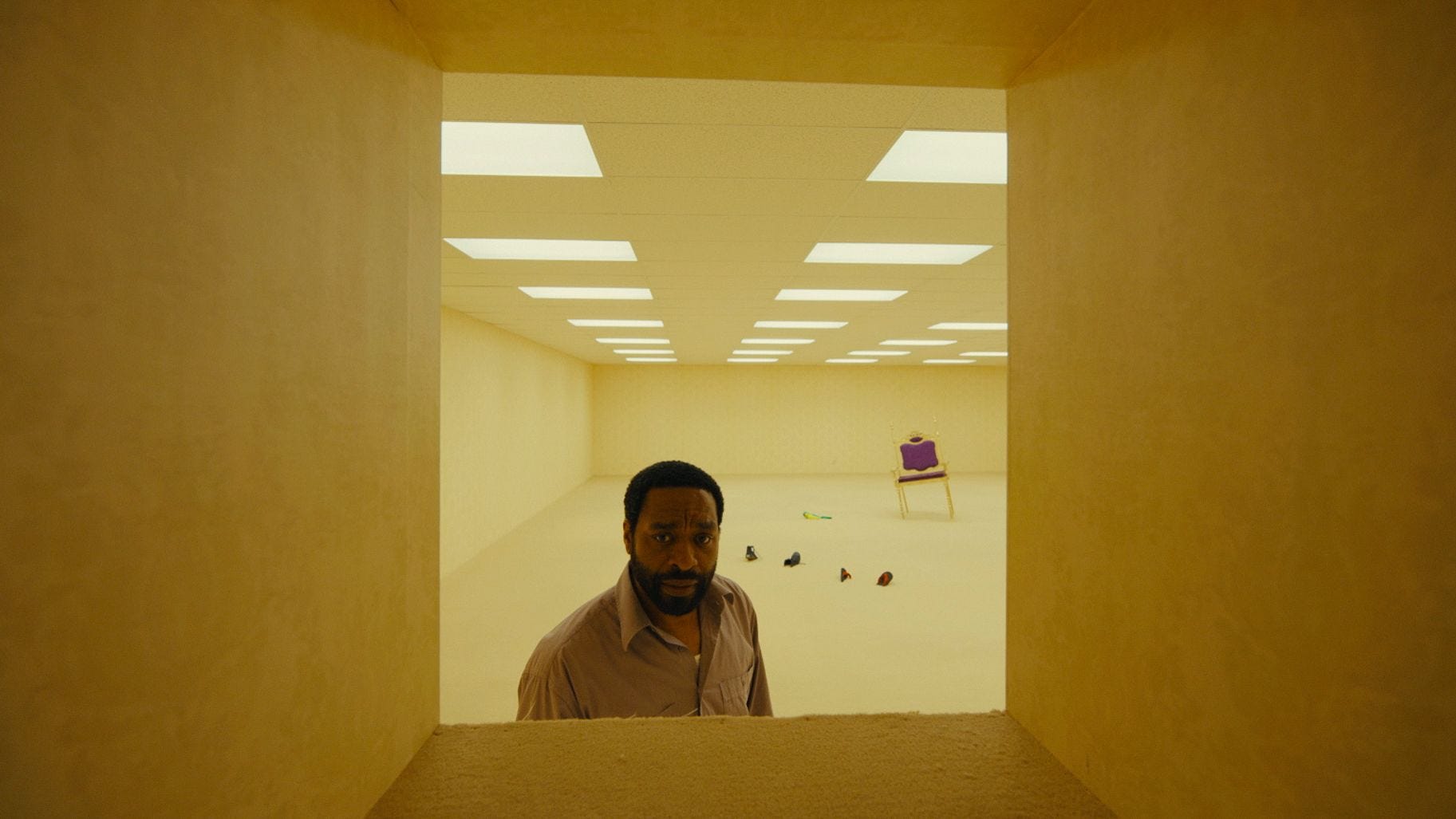
It’s beyond encouraging to see a whole generation turn out in droves ($80 million in the opening weekend, doubling the $40 million projection!) for a challenging, abstract, Escherian film about how memory is externalized and transforms when we stare at it for too long. The Kids are Alright.
In an interview with Curry Barker, the content creator turned director stated that his inspiration for Obsession came from a Simpsons episode where someone uses a monkey’s paw in a Treehouse of Horror episode.1 Kane Parsons has divulged similar inspirations, second order authority gained from the already refracted first order object. Much like Barker is in conversation with the thing once removed, Parsons is confronting a culture he’s never inhabited, only the deformed remnants left abandoned. Set in the 90’s, Backrooms is full of recognizable artifacts, everything has a veneer of quality with bones of plaster, Parsons is full of VHS-era nostalgia for a place he’s never been, grasping at glitchy ephemera in the pre-digital age. I wouldn’t be surprised if White Noise (the novel) is cited as a strong influence; the constant hum of the information-age irradiating every second of our lives. The disillusionment isn’t new, but the angle at which he approaches it is fascinatingly metaphysical and fresh.
Clark (Chiwetel Ejiofor), of the intentionally incongruous Captain Clark’s Ottoman Empire, is a recently divorced, failed architect that struggles to communicate and control his anger. He discovers the Backrooms after finding a seam in the paneling of his store (a great detail is that he’s freaking out over the rising electric bill caused by miles of lit underground tunnels). After Clark’s disappearance, his therapist, Mary (Renata Reinsve), goes to his store and pokes her head around, stumbling into the Backrooms, where Clark has made his new home, free to indulge in his worst impulses. I found that knowing as little as possible about the plot specifics worked in the movie’s favor, always unsure about what was around the corner.
The aspect of the film that works the best is the non-linear exploration of the titular Backrooms; Parsons is patient beyond his years, meting out handheld-cam fever dreams reminiscent of the lo-fi YouTube series. Even if you’re not familiar with the lore (starting with the anonymous 4chan post and unspooling from the minds of various redditors), it’s welcoming you to venture in to the yellow wallpapered maze and lose yourself to the ambiance. The mystery is most exciting when it remains just that —a mystery, a worse version of this movie would spoonfeed every bit of ASYNC backstory. All the recognizable table setting to get Ejiofor and Reinsve together in the Backrooms (she is his therapist working to get him to take responsibility for his actions and “open the window to your own self”) breaks the spell that the film has you under. The tedium of the therapy sequences and flashbacks showing the nugget of trauma that the characters have to overcome feel like eating your vegetables compared to wandering liminal spaces.
4 Peg Legs/5
Euphoria Season 3 created by Sam Levinson
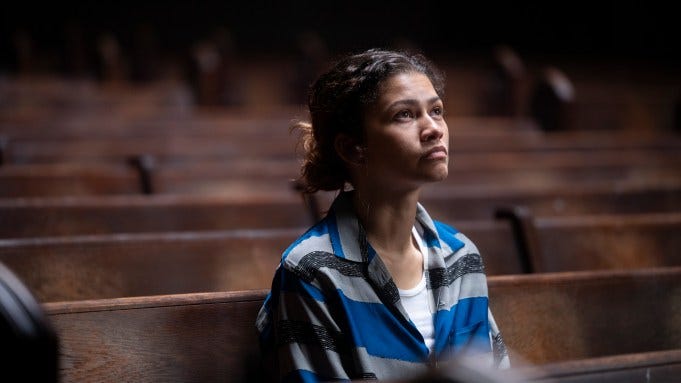
In God We Trust. The capper to the season and (most likely) the show is titled after the official motto of the United States; plastered over currency, it’s a garish proclamation of the church’s marriage to state, giving credence to our actions by righteous decree; American Exceptionalism. That could very well be the thesis to the latest season of Euphoria; a show that began as a hyper-stylized melodrama has mutated into a sprawling, decadent satire leading to an attempted Christian revival, touting the virtues of the nuclear family. The incongruity between tracking shots of a BBL through a strip club and virginal landscapes has been the strength of the show for a long time, but the show is at it’s visual best when the dichotomy is held in the same image; a Haloed OF starlet, a blinged out Jesus piece, pills strewn around a Mary-figure. It’s never subtle,
For a season so steeped in nihilism dead-set on speedrunning hedonism, the hard downshift to wholesome picket-fence optimism is jarring. Levinson takes us down memory road when -SPOILER- Rue overdoses 45 minutes in to a 90 minute episode, shifting the focus to her Sponsor, Ali (Colman Domingo). I could watch Domingo wax poetic about Good vs. Evil for an entire season of television, but when he spells out the philosophy of the show for the third time, it loses a lot of punch, and simplifying the world to “you’re either making the world a better place or making it worse” is a weak way to justify his vendetta against Alamo, the man who enabled Rue’s death. What’s even worse is preaching immorality at every turn; the drug market that enables the trafficking of Fentanyl into this country is chastised from the government agencies that don’t crack down to the low level dealers on street corners and not one bit of it rings true coming from the show that glorifies it all, you can’t have your cake and eat it too.
The dumbing down doesn’t stop there; in a conversation between Cassie (Sydney Sweeney) and Lexi (Maude Apatow), they reminisce on their father and Rue’s passing, guilt, and The Bible, basically landing on “keep on truckin’.” It makes me think that Levinson believes he has these sweeping ideas about the world and how we should lead our lives but the only way he can get them across is by putting them in plain terms and only while Sweeney is handling a dildo.
Of the characters left by the wayside in a scramble to tie off every loose end, Jules gets the shortest shrift. Hunter Schafer gets one meager scene and nary a line of dialogue, the whole season a waste of her talents, it’s like the creators forgot how to write for her. The holiday special that Levinson and Schafer co-wrote is long lost memory, her current arc cheapening her complex character into a petulant trophy, content to be wasting away as an exotic bird for a wealthy white man painting portraits of Rue as a tragic figure caught in chaos.
Euphoria is an undeniably beautiful show until the bitter end, loudly filmed in VistaVision, there are sequences that show the limits of what’s possible on the silver screen, if only superficially. Levinson has his eyes set on the fabric of the country, extolling the virtues of yesteryear, Coca-Cola bottles, Cowboys kicking up dust, duels, military uniforms, American flags, muscle cars all punctuate his ideation, culminating with Ali saying grace at a White Christian family’s dinner, a reconstruction of Rockwell’s Freedom From Want, a shockingly republican coda for the ultra self-indulgent liberational thesis of Euphoria. “May God Bless us all.”
https://collider.com/the-simpsons-obsession-treehouse-of-horror-2-monkey-paw-episode/
It's fascinating to see that particular generation and their fondness for the 90's. I was in my thirties when I was down with an 18 year old kid who had pop culture interests. After a while, it became clear he just wanted to pick my brain about how the 90's were, what people were like socially, what movies were like, how attitudes had changed. Every day, he'd be like, "Tell me about Clinton," or "Tell me about Seinfeld" or (because he was gay) "How did they treat gay people compared to today?" It felt like he was nostalgic for a time he'll never experience.